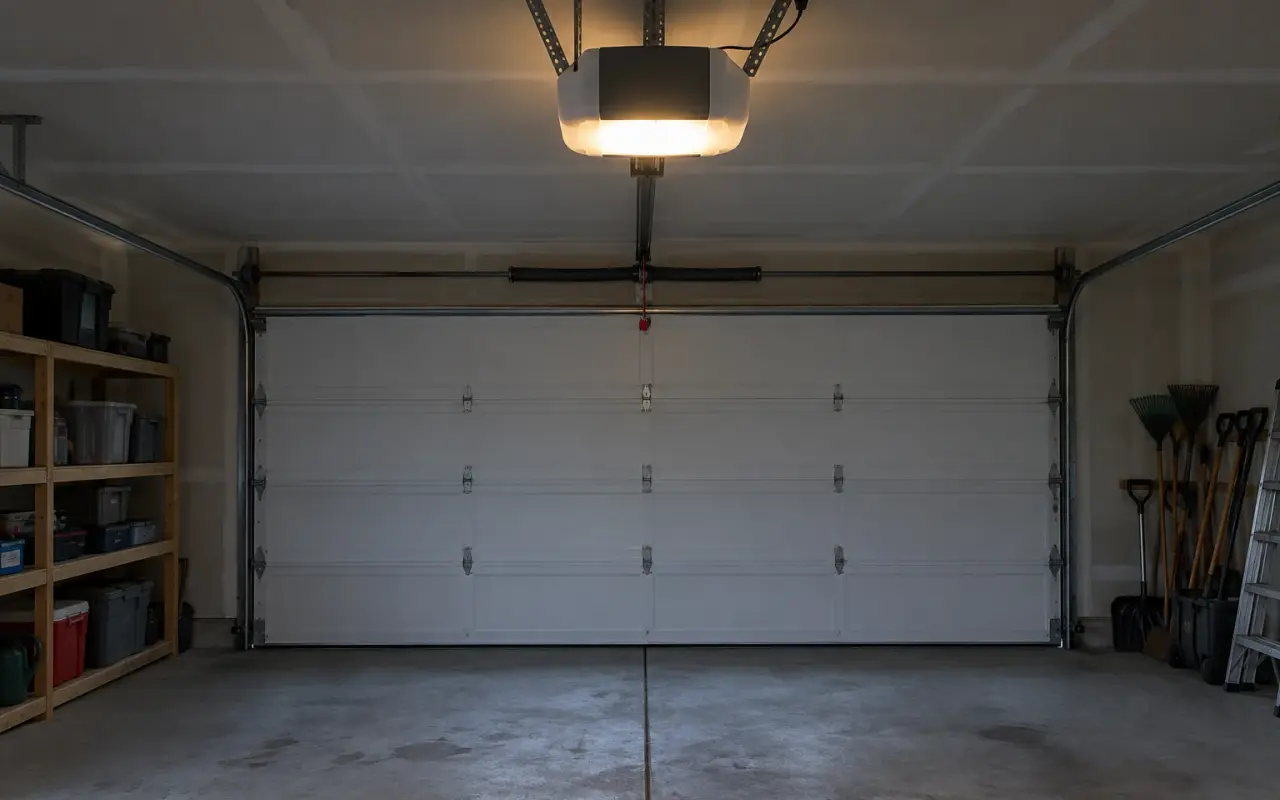
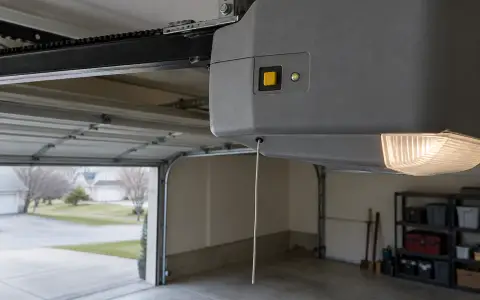
A LiftMaster or Chamberlain opener reports trouble two ways: the light bulbs on the motor unit flash, and, on newer models, the up and down arrow buttons on the motor unit flash a two-number code. The meanings below are from Chamberlain's owner's manual for its belt drive openers HD620EVC and LC1000EVC. Other models use the same scheme, but the chart printed in your own manual is the one to trust.
The lights flash 10 times
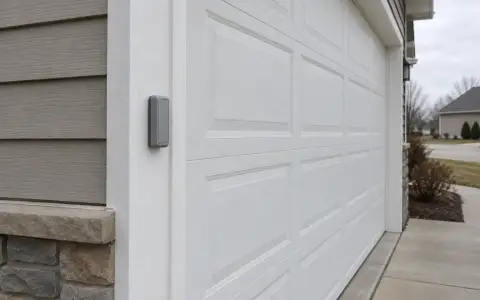
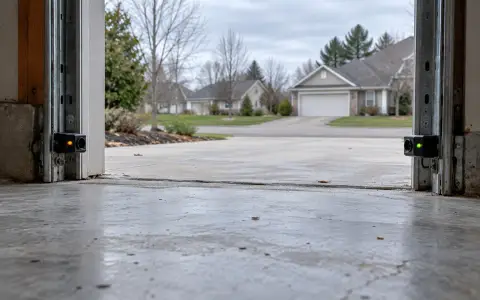
This is the most common one, and it is about the safety sensors: the two small eyes on either side of the door, mounted no more than 6 inches above the floor. The manual: "When the light beam is obstructed or misaligned while the door is closing, the door will reverse and the garage door opener lights will flash ten times. If the door is already open, it will not close."
What to check:
- Look at the LEDs on both sensors. The sending sensor has an amber LED and the receiving sensor a green one. "The LEDs in both sensors will glow steadily if they are aligned and wired correctly." Off or flickering means a problem on that side.
- Clear the path. Anything in the beam counts, including something hanging from the door or a bin pushed against the track.
- Wipe the lenses and realign: loosen the wing nuts, point the sensors at each other, tighten.
- Sunlight. If the receiving sensor faces direct sun, the manual suggests swapping the two sensors so the receiver is on the other side of the door.
To get a door closed while you sort it out, the same manual says you can hold the button on the wall control, or on the keypad, until the door is fully closed. Watch the door the whole way down: it is closing without the sensor beam watching the opening.
More on this in door won't close.
The lights flash 5 times
According to the manual, five flashes during travel setup mean "the programming has timed out". Start the travel programming again. Ten flashes during travel setup point to the sensors, as above.
The up and down arrow codes
On models with arrow buttons on the motor unit, a code is a number of flashes of the UP arrow followed by a number of flashes of the DOWN arrow. Count both, then look up the pair.
| Up | Down | What the manual says it means | First thing to check |
|---|---|---|---|
| 1 | 1 | Door will not close, lights flash. Safety sensors not installed, not connected, or a wire may be cut. | Sensor wires at every staple and connection. |
| 1 | 2 | Door will not close, lights flash. Short or reversed wire for the safety sensors. | Sensor wire at staples and terminals. |
| 1 | 3 | Wall control does not work. Its wires are shorted or the control is faulty. | Wall control wires at staples and terminals. |
| 1 | 4 | Door will not close, lights flash. Sensors misaligned or briefly obstructed. | Realign until both sensor LEDs are steady. |
| 1 | 5 | Door moves 6 to 8 inches and stops or reverses; or only a single click; or a hum for 1 to 2 seconds with no movement. | Open and close the door by hand: binding, a broken spring, a locked door. |
| 1 | 6 | Door coasts after it has stopped. | Reprogram the travel, or have the door balanced by a trained technician. |
| 2 | 1 to 5 | No movement or sound. | The manual's remedy is a new logic board. |
| 3 | 2 | Cannot set the travel or keep its position. | The travel module's assembly. |
| 4 | 1 to 4 | Door stops or reverses while moving. | Binding first; if the door moves freely, reprogram the travel. |
| 4 | 5 | Opener runs about 6 to 8 inches, stops and reverses. Communication error to the travel module. | The travel module's connections. |
| 4 | 6 | Door will not close, lights flash. Sensors misaligned or briefly obstructed. | Realign until both sensor LEDs are steady. |
Codes that mean the door, not the opener
Code 1-5 (a door that stops after 6 to 8 inches, a single click, or a hum without movement) and code 4-1 to 4-4 can have the same cause: something is holding the door. The manual's first step for both is to open and close the door by hand to check for "binding or obstructions, such as a broken spring or door lock."
Do that only if the springs are whole. With the door closed, look at the spring above it, or along the tracks, for a gap in the coil. A door with a broken spring is not balanced, and lifting it by hand means lifting its full weight. The federal text in every residential opener's manual warns that "weak or broken springs may allow the door to fall rapidly, causing injury or death" (16 CFR 1211.16(b)(2)). See broken spring.
After any fix: the reverse test
The manual repeats it in several places: the safety reversal system must be tested every month and after any adjustment. Lay a 2-by-4 flat under the door and close it. The door must reverse when it touches the board. See the monthly reverse test.
Updated 2026-10-10.
 LiftMaster remote
 LiftMaster keypad
 Genie remote
 Genie keypad
 HomeLink in the car
 Erase all remotes
 Remote not working
 Craftsman remote and keypad
 Genie blink codes
 Safety sensors
 Travel limits and force
 myQ and Wi-Fi
 Universal remote
 Wall button not working
 Maintenance and lubrication
 Emergency release
 Battery backup
 Opener light bulbs