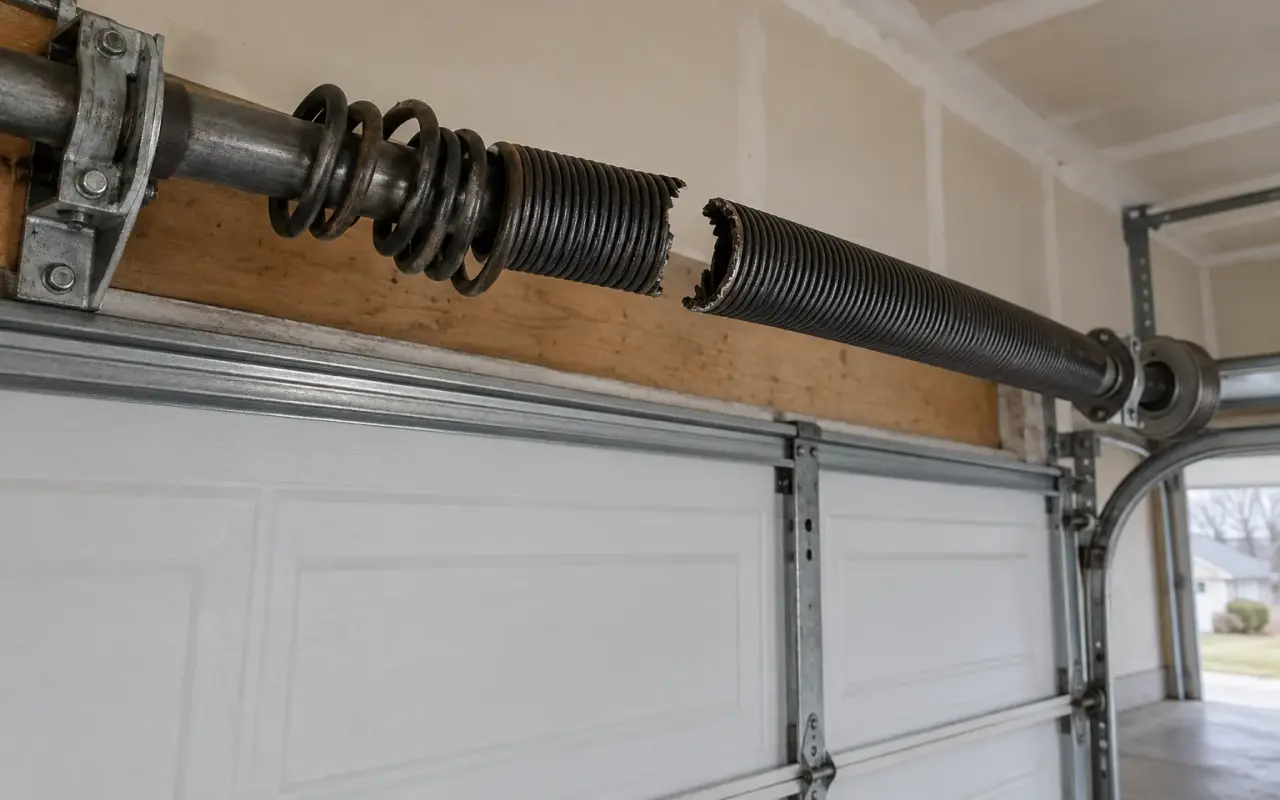
A spring usually announces itself. There is a bang from the garage, often when nobody is near the door, and afterwards the opener strains, lifts the door a few inches and stops, or gives up and reverses. If someone has already tried lifting it by hand, it felt far heavier than it did yesterday. That weight was always there. The springs were carrying it.
How to tell it is the spring
Look up before you touch anything.
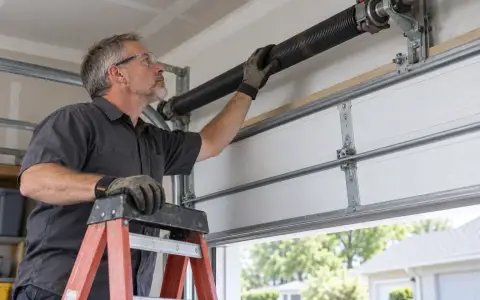
- A gap in the coil. On most newer sectional doors the spring is a tightly wound coil on a steel bar just above the door. A broken one has a visible gap of a few inches where the coil has separated.
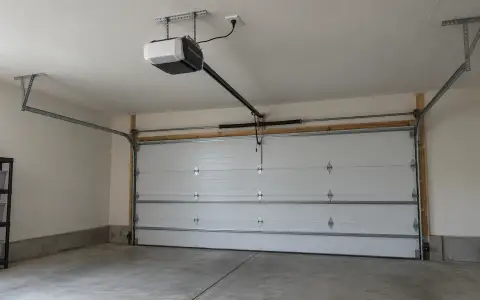
- A spring hanging loose along a track. Older and lighter doors use springs that run beside the horizontal tracks on each side. A broken one hangs slack or lies in pieces.
- A door that comes down fast. A door that drops faster than it used to when it closes has lost part of what holds it back.
- An opener that runs and a door that barely moves. The opener is built to move a door that the springs have balanced. It is not built to lift the whole weight.
Why this is not a job to take on yourself
The federal rule for garage door openers requires every owner's manual to carry the same safety text. Two of its lines are about exactly this situation:
Weak or broken springs may allow the door to fall rapidly, causing injury or death.
Have a qualified service person make repairs to cables, spring assemblies and other hardware.
— 16 CFR 1211.16(b)(2), text required in every residential opener's manual
The door industry's association says the same thing in its own safety sheet: doors are "large, heavy objects that move with the help of springs under extreme tension," and "only trained door systems technicians should remove, repair or adjust doors" (DASMA TDS #174).
On many doors the bolts that hold parts under spring tension are red. That is a requirement of the industry's standard for counterbalance systems, ANSI/DASMA 103, and the standard also calls for warning labels on the bottom corner brackets telling people not to remove them. A red bolt is not something to loosen, with the spring whole or broken.
What to do until someone comes
- Leave the door where it is. If it is closed, leave it closed. If it is open, keep people, pets and cars out from under it.
- Stop pressing the opener button. Each try asks the opener to lift weight the spring should be carrying.
- Do not pull the release cord to lift the door by hand. With the spring broken, nothing is holding the door's weight except you.
- If a car is inside and the door is shut, say so on the call. It changes how soon the visit needs to be.
How long springs last
One manufacturer, Amarr, states that standard residential springs are rated for about 10,000 cycles, one cycle being one opening and one closing. That is a manufacturer's figure, not a standard: the industry association does not publish a number, and lists the weight of the door (paint included), the climate and lubrication among the things that change it (DASMA TDS #190). A door that is opened many times a day uses up its cycles faster than one opened twice.
What the visit covers
A technician looks at both springs if there are two, at the cables and drums that the springs work through, and at the rollers and bearings. The price is named after that inspection, because it depends on what is found: the type of spring, whether one or both are replaced, the weight of the door, and whether anything else broke when the spring did. Once the door is back on its springs, it should be balanced and should pass the monthly reverse test described in the opener's manual. Ask to see both before the technician leaves.
Updated 2026-09-30.
 Snapped cable
 Off track
 Won't open
 Won't close
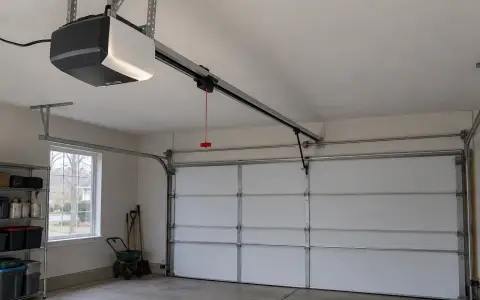 Opener runs, door doesn't
 Car hit the door
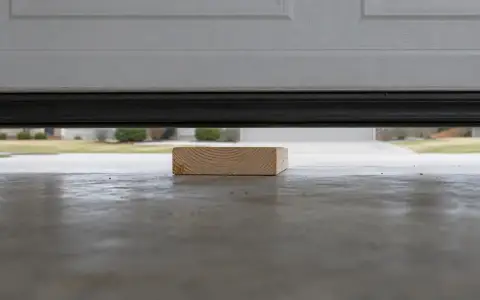 Reverse test
 Door replacement
 Opener replacement
 Wind-rated doors
 Before you call