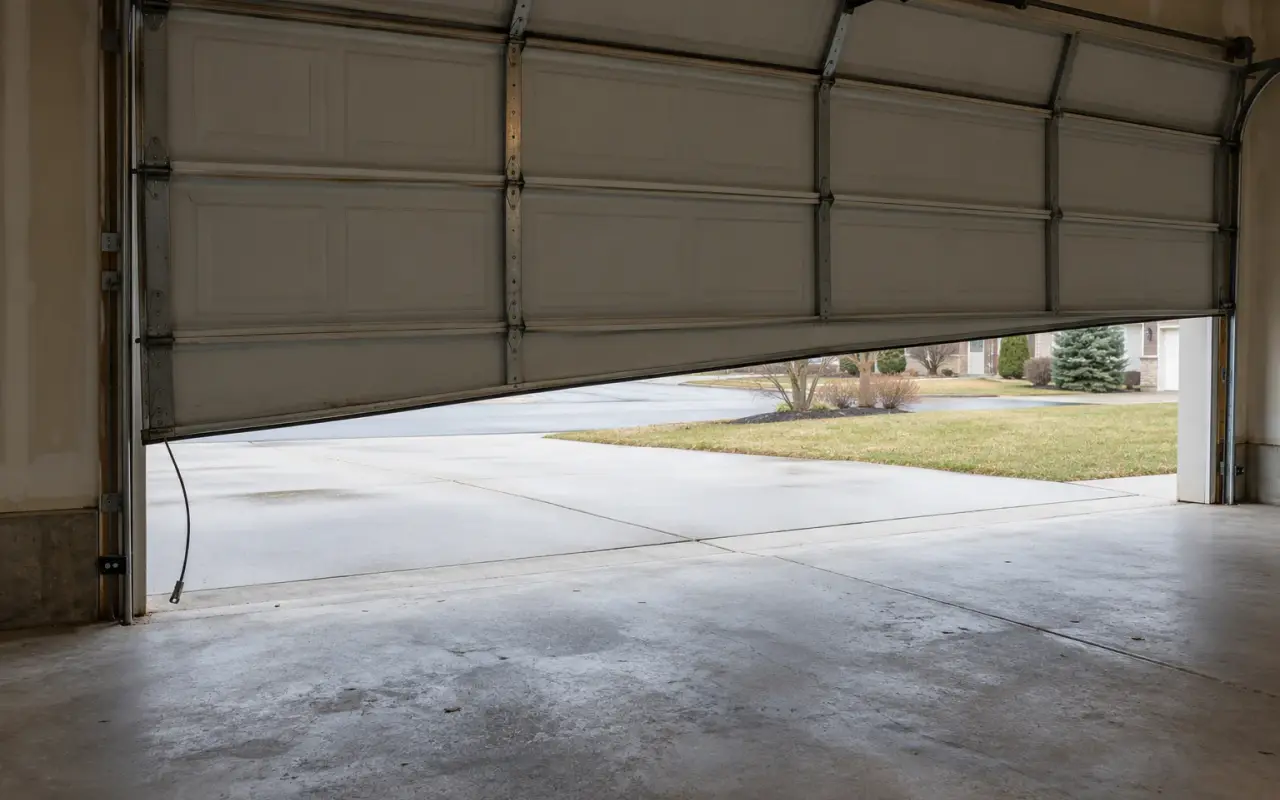
A garage door is lifted at its two bottom corners by steel cables. The springs supply the force, and the cables carry it down to the door. When one cable breaks or slips off its drum, that corner loses its lift and the other one does not, so the door comes up or down at an angle, jams in the tracks, or stops partway with a gap on one side.
Signs it is a cable
- The door hangs crooked, one bottom corner lower than the other.
- A cable hangs loose beside a track instead of running taut up the side of the door.
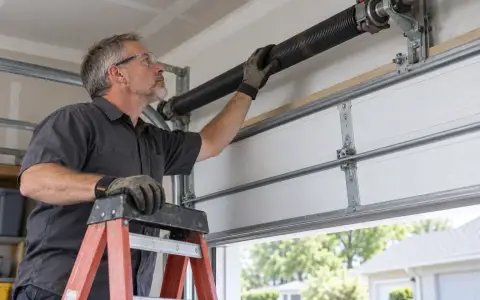
- At the top, the cable has unwound from the grooved drum at the end of the spring bar.
- The door stops partway and the opener reverses, or the door sticks in the tracks.
Why the cable is tied to the spring
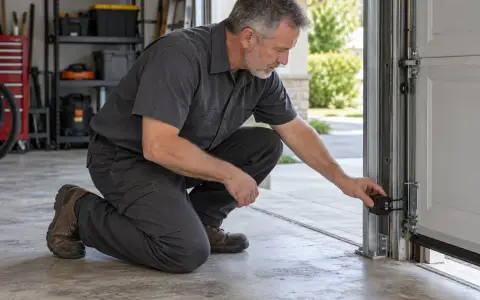
The bottom brackets the cables attach to are under spring tension, which is why the industry standard for counterbalance systems, ANSI/DASMA 103, requires the fasteners holding tensioned parts to be red and calls for labels warning people not to remove them. The same standard requires a spring to be restrained so that a broken one is held in place. A cable problem is therefore a spring-system problem, and the federal text in every residential opener's manual names cables alongside springs:
Have a qualified service person make repairs to cables, spring assemblies and other hardware.
— 16 CFR 1211.16(b)(2), text required in every residential opener's manual
What to do until someone comes
- Do not run the opener. A crooked door driven by a motor twists further into the tracks. The Consumer Product Safety Commission's advice is plain: "If doors are not 'balanced,' or if they bind or stick, they should be serviced by a professional" (CPSC Pub. 523).
- Keep everyone out from under it. A door held on one cable is held by half of what should hold it.
- Do not try to rewind the cable onto the drum or pull the door level by hand. The cable is carrying spring force.
- Look at the springs from a distance. If one has a gap, say so on the call. Cables and springs share the load, and the technician checks both.
What the visit covers
A technician secures the door, looks at both cables, both drums, the springs, the bottom brackets and the rollers, and checks whether the tracks were bent while the door hung crooked. The price is named after that inspection. When the door is back in service it should run level, stay balanced, and reverse on contact as the opener's manual requires.
Updated 2026-09-30.
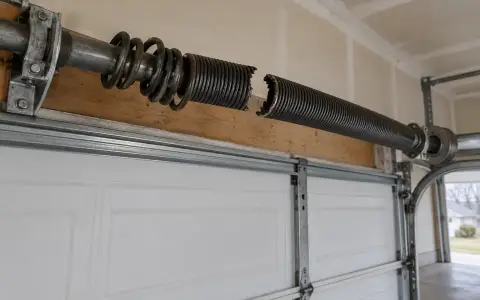 Broken spring
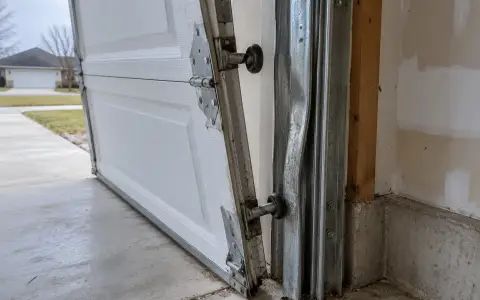 Off track
 Won't open
 Won't close
 Opener runs, door doesn't
 Car hit the door
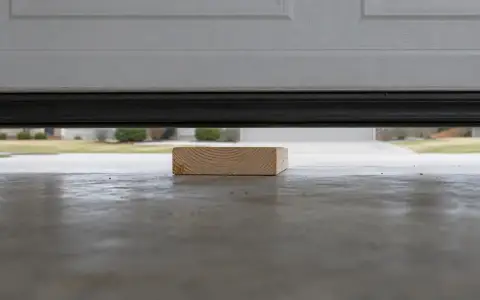 Reverse test
 Door replacement
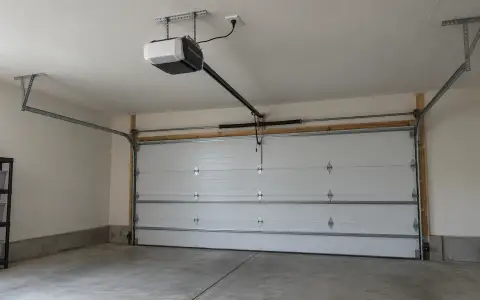 Opener replacement
 Wind-rated doors
 Before you call