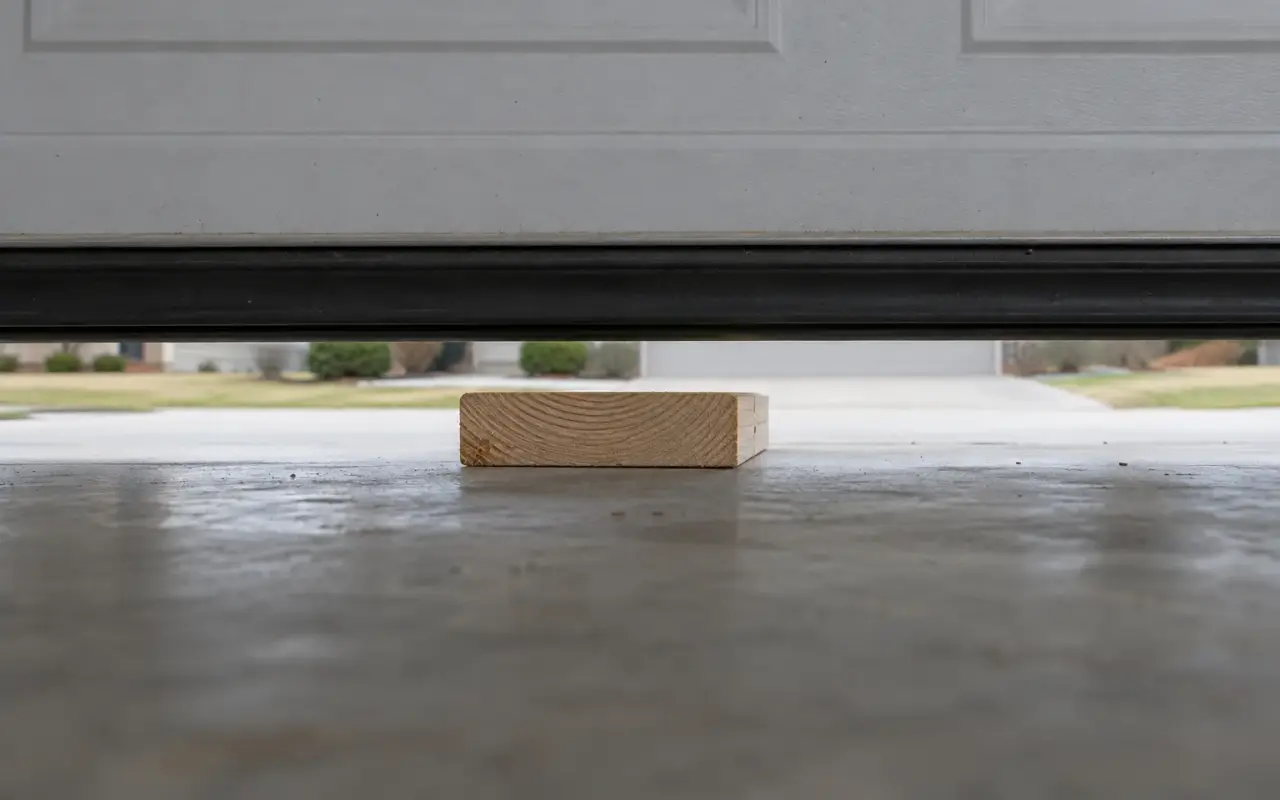
Every residential garage door opener made for sale in the United States comes with the same instruction, because federal law requires the manual to print it:
Test door opener monthly. The garage door MUST reverse on contact with a 1½ inch object (or a 2 by 4 board laid flat) on the floor.
— 16 CFR 1211.16(b)(2)
How the test works
- Open the door fully.
- Lay a piece of 2-by-4 flat on the floor in the middle of the opening, under where the door lands.
- Close the door with the opener.
- Watch what happens when it meets the board. It should stop and go back up. The federal performance requirement is that a closing door "initiate reversal of the door within 2 seconds of contact with the obstruction" (16 CFR 1211.7(b)(1)(i)).
Stand clear while it runs, and keep children and pets out of the garage during the test.
If it does not reverse
The Consumer Product Safety Commission's instruction is specific:
If the door does not properly reverse when striking the 2x4 then the garage door opener should be disengaged until the unit is either adjusted …, repaired, or replaced
— CPSC Publication 523
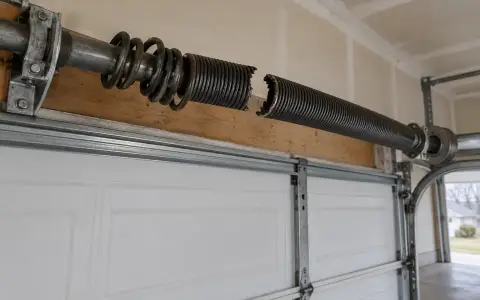
Disengaging means disconnecting the door from the opener, as the manual describes, so that it can only be moved by hand. Do this only if the springs are whole, and with the door closed if at all possible: the federal text in the manual says to "use the emergency release only when the door is closed" where possible, and to use caution with the door open. A door with a gap in a spring should not be moved at all: see broken spring.
The same publication adds a broader check: "Inspect the garage door and the garage door opener every 30 days to make sure they are working properly."
Why the rule exists
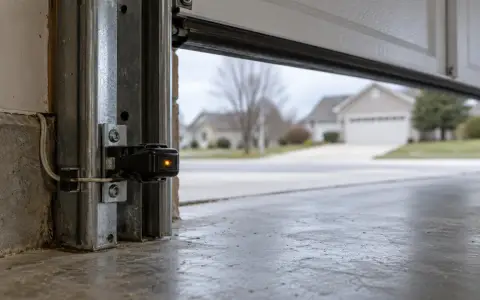
The reversal requirement came from deaths. As of its 2011 revision, the same CPSC publication reported that about 73 children between the ages of 2 and 14 had been trapped and killed under automatic garage doors since March 1982, about three a year. Openers made for sale after January 1, 1991 have had to reverse, and a second, external protection, usually photo-eye sensors near the floor, was required from 1993. An opener older than that may pass neither part of the test.
Two states that go further
- California. A person hired to service or repair a residential opener must, when finished, check whether it reverses on contact with a rigid obstacle two inches high (Health & Safety Code § 19890(e)). An opener that fails gets a red certificate from the technician, as the same section requires.
- Minnesota. No one may service or repair a residential opener that does not meet the automatic reversing requirement, unless the work will bring it into compliance (Minn. Stat. § 325F.83).
When the test calls for a visit
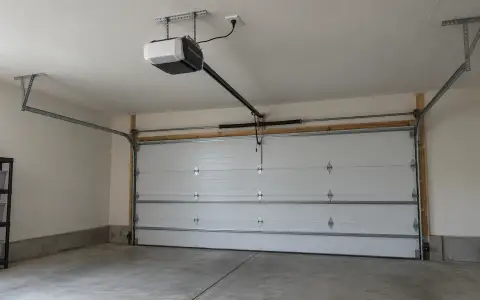
Call when the door does not reverse, when it reverses only after pressing down hard on the board, or when the opener is old enough that it has no sensors near the floor. Whether the answer is an adjustment, a repair or a new opener is decided after the technician has seen it; see opener replacement.
Updated 2026-09-30.
 Broken spring
 Snapped cable
 Off track
 Won't open
 Won't close
 Opener runs, door doesn't
 Car hit the door
 Door replacement
 Opener replacement
 Wind-rated doors
 Before you call